
Everything You Need to Know About Engineered Quartz Stone
From raw material science to finished surfaces — the definitive knowledge hub for importers, distributors, fabricators, and project specifiers working with engineered quartz stone.
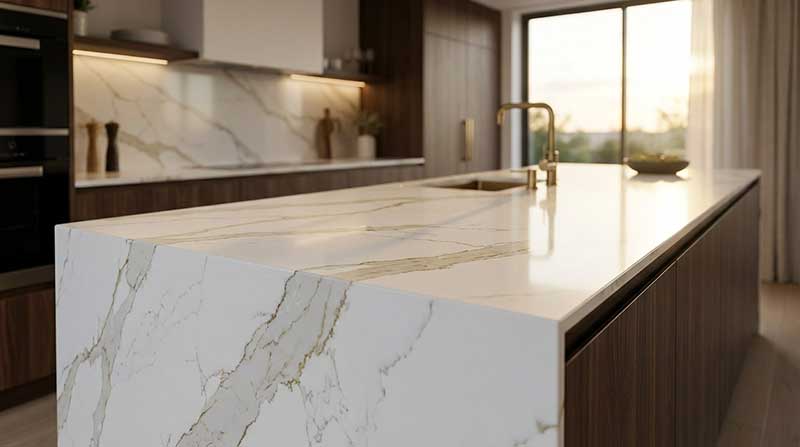
Our Collection
What is Engineered Quartz Stone?
Engineered quartz stone is a man-made surface material composed of approximately 90–94% crushed natural quartz crystals, combined with 6–10% polymer resins, pigments, and additives. Through a sophisticated manufacturing process involving vacuum vibration compression and high-temperature curing, these raw materials are transformed into dense, non-porous slabs that offer exceptional durability and aesthetic consistency.
Unlike natural stone such as granite or marble, engineered quartz offers uniform color and pattern across every slab — a critical advantage for large-scale commercial projects and consistent production runs. Its non-porous surface means it resists staining, bacterial growth, and moisture penetration without the need for periodic sealing.
For B2B buyers, understanding the composition, manufacturing variables, and performance characteristics of engineered quartz is essential for making informed sourcing decisions. This site serves as your comprehensive guide.
Mohs Hardness 7
Scratch resistant surface
Near-Zero Porosity
No sealing required
200+ Designs
Consistent batch to batch
NSF & CE Certified
Global quality standards
Explore by Application
Where Engineered Quartz Excels
Discover how engineered quartz stone performs across different application scenarios. Each guide covers material specifications, design considerations, and sourcing tips for B2B buyers.
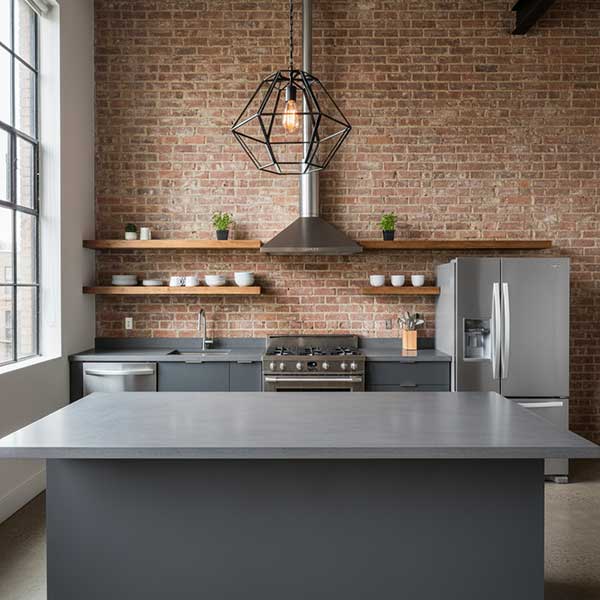
The most popular application for engineered quartz. Explore slab sizes, edge profiles, thickness options, and why quartz outperforms granite in modern kitchens.
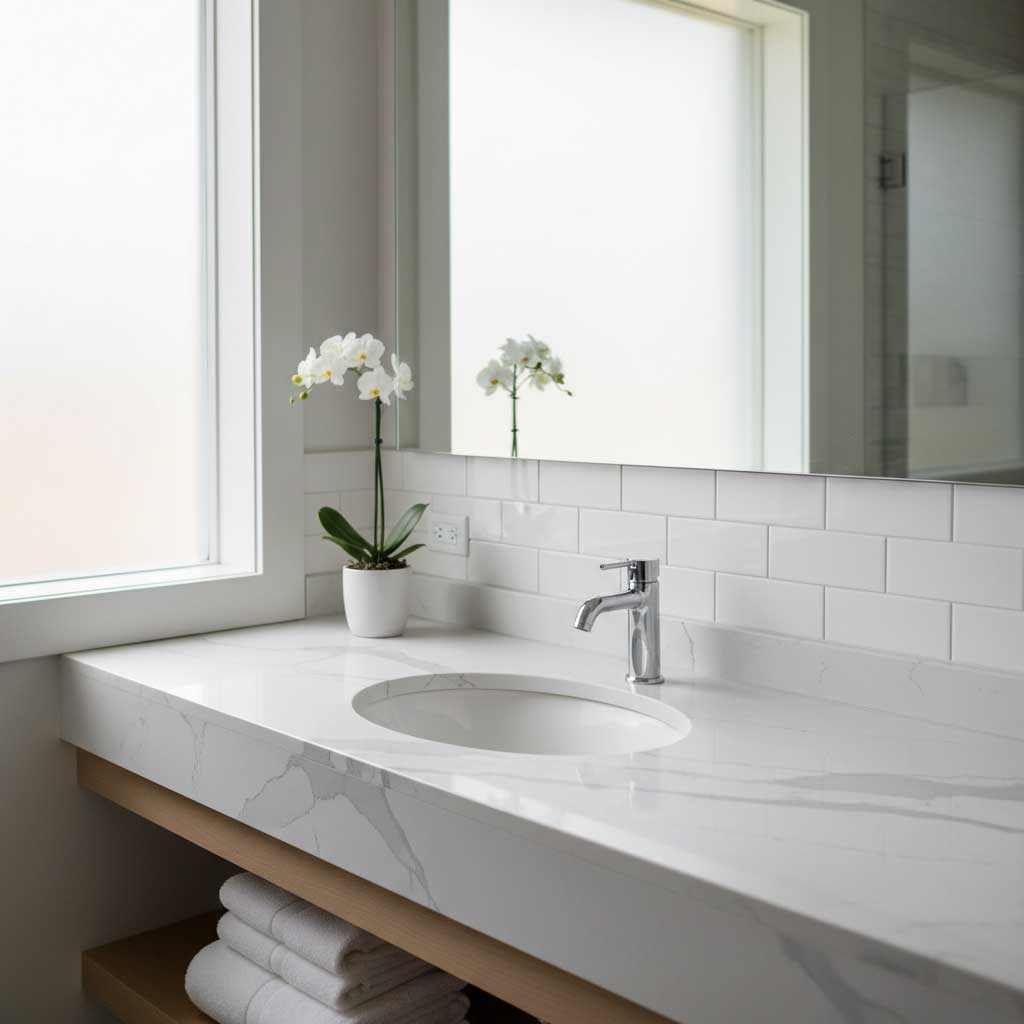
Non-porous and moisture resistant — ideal for humid bathroom environments. Learn about integrated sinks, backsplash options, and hospitality-grade specifications.
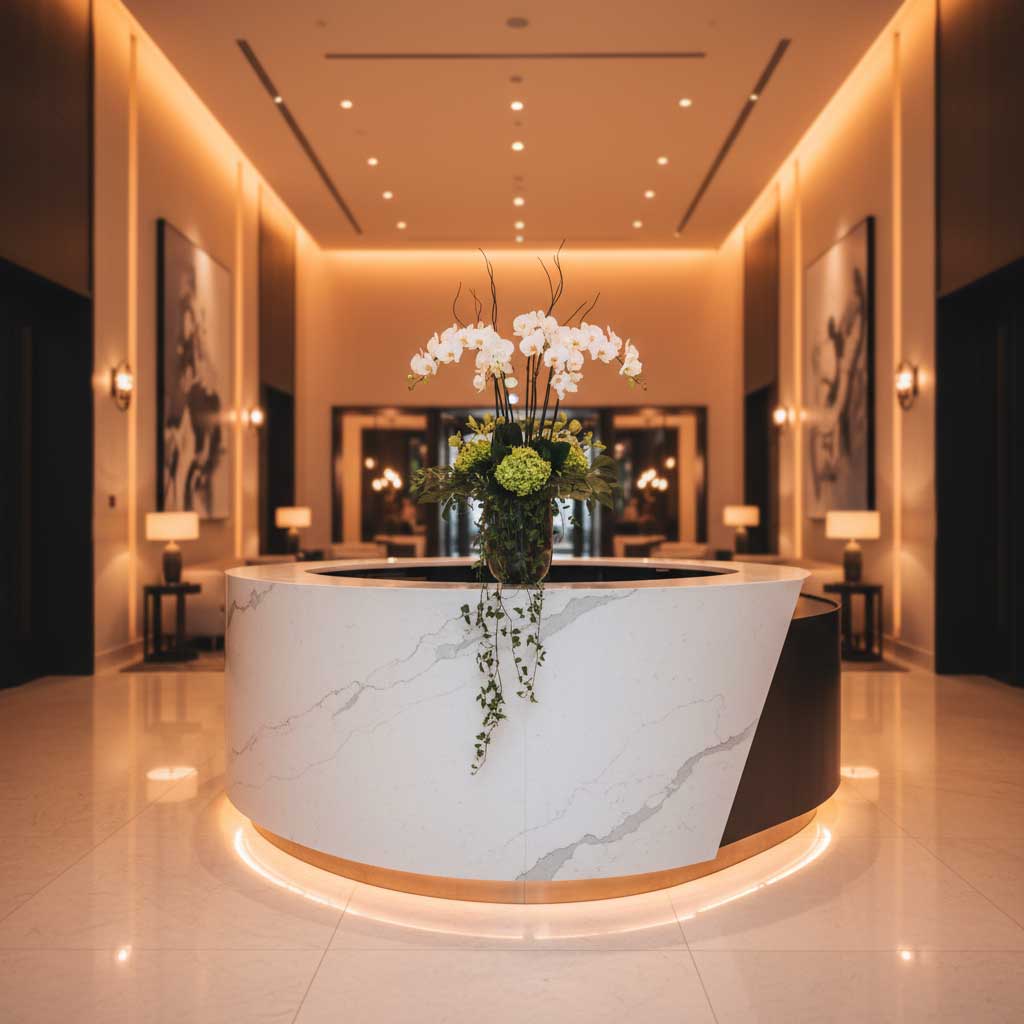
Hotels, offices, restaurants, and retail spaces demand high durability and color consistency across large orders. Explore project case studies and bulk specifications.
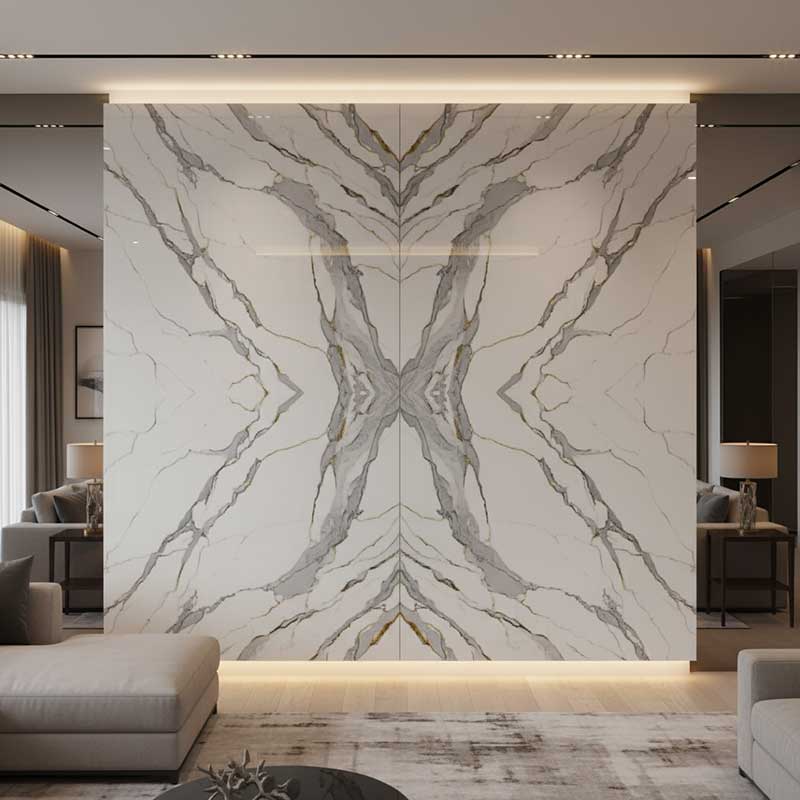
Feature walls and accent surfaces in residential and commercial interiors. Learn about lightweight thin-panel options and bookmatched veining effects.
From Raw Material to Finished Slab
The Manufacturing Process
Understanding how engineered quartz stone is made helps buyers evaluate quality differences between suppliers. Here’s an overview of the six critical production stages.
1
Raw Material Selection
High-purity quartz sand and crystals are sourced and graded by particle size. The quality of raw quartz directly impacts the final slab’s hardness, clarity, and color accuracy. Premium manufacturers use quartz with 99.5%+ SiO₂ purity.
2
Mixing & Blending
Quartz granules of various sizes are precisely combined with unsaturated polyester resin, coupling agents, and pigments. The ratio and blending uniformity at this stage determine the slab’s structural integrity and visual consistency.
3
Vibro-Compression
The mixture is poured into molds and subjected to vacuum vibration compression at approximately 100 tons of pressure. This eliminates air pockets and creates an ultra-dense, non-porous material with water absorption rates below 0.02%.
4
High-Temperature Curing
Compressed slabs are cured in kilns at temperatures exceeding 90°C for 30–45 minutes. This process hardens the resin matrix and bonds it permanently with the quartz crystals, resulting in a Mohs hardness rating of 7.
5
Calibrating & Polishing
Slabs are calibrated to precise thicknesses (typically 12mm, 20mm, or 30mm) and polished through a multi-head grinding sequence. Surface finishes range from high-gloss mirror polish to honed, leathered, or concrete-look textures.
6
Quality Inspection
Every slab undergoes rigorous quality control: dimensional accuracy, surface flatness, color consistency, flexural strength testing, and visual inspection for defects. Only slabs meeting international standards (EN 15286, NSF/ANSI 51) pass for export.
Material Comparison
A data-driven comparison to help buyers understand the practical advantages of engineered quartz over natural granite and marble in commercial and residential applications.
| Property | Engineered Quartz | Granite | Marble |
|---|---|---|---|
| Hardness (Mohs Scale) | 7 ★ | 6 – 7 | 3 – 5 |
| Water Absorption Rate | < 0.02% | 0.1 – 0.4% | 0.2 – 0.6% |
| Requires Sealing | No | Annually | Frequently |
| Color Consistency | Excellent | Variable | Highly Variable |
| Stain Resistance | Excellent | Good | Poor |
| Flexural Strength | 45 – 55 MPa | 10 – 20 MPa | 6 – 15 MPa |
| Heat Resistance | Up to 150°C | Excellent | Good |
| Color Options | 200+ (Customizable) | Natural Only | Natural Only |
| Price Range (FOB) | $15 – $45/m² | $18 – $80/m² | $25 – $150/m² |
| Batch Uniformity | Identical | Each slab unique | Each slab unique |